Translate to your own language

Become a member of ADDY as me with my link and get $25 to kickstart your own investing journey 🏠

Showing posts with label sun. Show all posts

October 08, 2019

Caribbean for all of us (The Best Beaches)

Image courtesy of Phil Thebault at FreeDigitalPhotos.net
The Best Beaches
Good beaches with soul-warming sun, crystal-clear waters, and fragrant sea air can be found on virtually every island of the Caribbean, with the possible exceptions of Saba (which has rocky shores) and Dominica (where the few beaches have dramatically black sands that absorb the hot sun).

Shoal Bay (Anguilla): This luscious stretch of silvery sand helped put Anguilla on the world-tourism map. Snorkelers are drawn to the schools of iridescent fish that dart among the coral gardens offshore. You can take the trail walk from Old Ta to little-known Katouche Beach, which offers perfect snorkeling and is also a prime site for a beach picnic under shade trees.

The Beaches of Antigua: Legend has it that there is a beach here for every day of the year, though we haven't bothered to confirm that by counting. Antiguans claim, with justifiable pride, that their two best beaches are Dickenson Bay, in the northwest corner of the island, and Half Moon Bay, which stretches for a white-sandy mile along the eastern coast. Most major hotels open directly onto a good beach, so chances are good yours will be built on or near a strip of white sand.

Palm Beach (Aruba): This superb white-sand beach put Aruba on the tourist map. Several publications, including Condé Nast Traveler, have hailed it as 1 of the 12 best beaches in the world. It's likely to be crowded in winter, but for swimming, sailing, or fishing, it's idyllic.

The Gold Coast (Barbados): Some of the finest beaches in the Caribbean lie along the so-called Gold Coast of Barbados, site of some of the swankiest deluxe hotels in the Northern Hemisphere. Our favorites include Paynes Bay, Brandon's Beach, Paradise Beach, and Brighton Beach, all open to the public.

Cane Garden Bay (Tortola, British Virgin Islands): One of the Caribbean's most spectacular stretches, Cane Garden Bay has 2km (1 1/4 miles) of white sand and is a jogger's favorite. It's a much better choice than more obvious (and more crowded) Magens Bay beach on neighboring St. Thomas.

Seven Mile Beach (Grand Cayman, Cayman Islands): It's really about 9km (5 1/2 miles) long, but who's counting? Lined with condos and plush resorts, this beach is known for its array of watersports and its translucent aquamarine waters. Australian pines dot the background, and the average winter temperature of the water is a perfect 80°F (27°C).

The Beaches of the Dominican Republic: There are two great options here: the beaches of resort-riddled Punta Cana at the easternmost tip of the island, or those at Playa Dorada along the northern coast, which fronts the Atlantic. Punta Cana is a 32km (20-mile) strip of oyster-white sands set against a backdrop of palm trees, and Playa Dorada is filled with beaches of white or beige sands.

Grand Anse Beach (Grenada): This 3km (2-mile) beach is reason enough to go to Grenada. Although the island has some 45 beaches, most with white sand, this is the fabled one, and rightly so. There's enough space and so few visitors that you'll probably find a spot just for yourself. The sugary sands of Grand Anse extend into deep waters far offshore. Most of the island's best hotels are within walking distance of this beach strip.

Seven Mile Beach (Negril, Jamaica): In the northwestern section of the island, this beach stretches for 11km (6 3/4 miles) along the sea, and is backed by some of the most hedonistic resorts in the Caribbean. Not for the conservative, the beach also contains some nudist sections along with bare-all Booby Cay offshore.

Diamond Beach (Martinique): This bright, white-sandy beach stretches for about 10km (6 1/4 miles), much of it developed. It faces a rocky offshore island, Diamond Rock, which has uninhabited shores.

Luquillo Beach (Puerto Rico): This crescent-shaped public beach, 30 miles east of San Juan, is the local favorite. Much photographed because of its white sands and coconut palms, it also has tent sites and picnic facilities. The often-fierce waters of the Atlantic are subdued by the coral reefs protecting the crystal-clear lagoon.

St-Jean Beach (St. Barthélemy): A somewhat narrow, golden sandy beach, St-Jean is the gem of the island, reminiscent of the French Riviera (though you're supposed to keep your top on). Reefs protect the beach, making it ideal for swimming.

The Beaches of St. Maarten/St. Martin: Take your pick. This island, divided about equally between France and the Netherlands, has 39 white-sandy beaches. Our favorites include Dawn Beach, Mullet Bay Beach, Maho Bay Beach, and Great Bay Beach on the Dutch side. Orient Beach is another standout -- not because of its sands but because of the nudists.

Canouan (The Grenadines): Most of the other beaches recommended in this section have been discovered and may be crowded in winter. But if you're looking for an idyllic, secluded stretch of perfect white sand, head for the remote and tiny island of Canouan, one of the pearls of The Grenadines, a string of islands lying south of its parent, St. Vincent. You'll have the beaches and the crystal-clear waters to yourself, even in winter.

The Beaches of Tobago: For your Robinson Crusoe holiday in the southern Caribbean, head to the little island of Tobago. Even Trinidadians fly over here on weekends to enjoy the beach life. It doesn't get any better than a long coral beach called Pigeon Point on the northwestern coast. Other good beaches on Tobago include Back Bay (site of an old coconut plantation) and Man-O-War Bay, known for its beautiful natural harbor and long stretch of sand.

Grace Bay Beach (Providenciales, Turks and Caicos Islands): These 19km (12 miles) of pale sands are the pride of Provo; Condé Nast Traveler has called this one of the world's best beaches. It's such a spectacular setting that increasing numbers of resorts, including Club Med, have sprung up along the shore. A couple of miles out from the northern shore, the beach is fringed by a reef with fabulous snorkeling. Back on land, there are plenty of places where you can rent watersports equipment.

Trunk Bay (St. John): Protected by the U.S. National Park Service, this beach is one of the Caribbean's most popular. A favorite with cruise-ship passengers, it's known for its underwater snorkeling trail, where markers guide you along the reef just off the white sands; you're sure to see a gorgeous rainbow of tropical fish.

October 23, 2015

Hit the sweet spot


500 mL of milk a day hits right balance for little kids


Can there be too much of a good thing when you are talking about little kids and cow's milk? A new study suggests there can.
By imagerymajestic/FreeDigitalPhotos.net
           Can there be too much of a good thing when you are talking about little kids and cow’s milk? A new study suggests there can.
The work, by scientists in Toronto, says that children between the ages of two and five should be drinking half a litre (about  17oz)  or approximately two eight-ounce cups of milk a day.
Less than that and kids may not be getting enough vitamin D, the study suggests. But more than that, and the stores of iron in their blood — which are essential for a developing brain — may start to slip below acceptable levels.
The study was led by Dr. Jonathon Maguire, a pediatrician and researcher at St. Michael’s Hospital in Toronto. It is published in this week’s issue of the journal Pediatrics.
“Cow’s milk is a very important staple in our western diet for children. I don’t want to underestimate the importance of cow’s milk,” Maguire said in an interview about the study.
“Our question was really: Well, how much?”
It’s a query pediatricians face all the time, Maguire said. And they haven’t had a good answer to give because experts are divided on the issue.
Some organizations have argued that young children should consume a litre of milk a day to get the vitamin D they need to build strong bones and avoid rickets, a formerly common bone-softening condition. (Milk is fortified with vitamin D.)
But other groups have warned that children’s consumption of cow’s milk should be curtailed because some studies have shown that kids who drink a lot of milk can have low levels of iron in their blood.
Low iron can lead to anemia, where the body produces too few of the red blood cells that transport oxygen throughout the body.
“It looks like in children who have iron deficiency severe enough to cause them ... to have anemia, those children have difficulties with their cognitive development. Over time they’re not quite as bright as other children,” Maguire said.
Iron deficiency in young children isn’t uncommon in Canada. While it’s just a guesstimate — Maguire said recent studies haven’t been done — it is believed between 10 per cent and 20 per cent of young children in Canada may have low iron stores.
Given the confusing advice and the fact that milk consumption by preschoolers seems to involve a trade-off between vitamin D and iron, Maguire and some colleagues decided to try to find the sweet spot.
They enrolled 1,311 healthy Toronto children ages two to five in a study, evaluating samples of their blood for vitamin D and iron stores and gathering information from parents about the amount of milk the kids drank.
The researchers found that about 500 millilitres of milk a day for most children was the right amount to have adequate levels of vitamin D and iron.
There was an exception: during winter, children with dark skin didn’t hit the vitamin D target with 500 mL daily. The study suggests in winter children with dark skin may need a vitamin D supplement as well as the milk.
The researchers also saw this previously reported inverse relationship, where more milk consumed meant higher vitamin D levels but lower iron stores.
What’s behind the puzzling interplay? The director of the nutrition and metabolism research program at B.C. Children’s and Women’s Hospitals said little kids who drink a lot of milk often aren’t eating enough solid foods to get the needed amount of iron. (There is little iron in milk.)
Read the whole story here: www.thespec.com

July 17, 2014

Are You Allergic to the Sun?


Are You Allergic to the Sun?
Image courtesy of FreeDigitalPhotos.net
By Christine Haran
Although die-hard sun worshipers continue to oil up to better catch the sun's tanning rays, most Americans choose to slather on sunscreen instead. Sunscreen can help protect them from most of the harmful effects of ultraviolet light, but it will do little for certain sun-sensitive individuals. These would-be sun seekers wind up with an itchy, bumpy rash that is sometimes called "sun poisoning" even if they're wearing SPF 50.

"Sun poisoning" is really an allergic reaction to the sun that occurs when skin is exposed to sunlight for the first time in the early spring, or during a winter vacation. While people with light skin are most susceptible to sunburn, sun allergy affects people of all skin colors.

If people with sun allergy venture to the beach at all, you can probably find them in a floppy hat, under an umbrella. Or, at least, that's where they should be. Below, Henry W. Lim, MD, chair of the department of dermatology at Henry Ford Hospital in Detroit, Michigan, talks about how to prevent and treat allergic reactions to the sun, as well as rashes triggered by sunscreen ingredients.
Can someone have a sun allergy?
There are certain skin reactions to the sun that have nothing to do with sunscreen or other external factors, which we call an intrinsic type of photodermatosis. People with photodermatosis develop skin rashes following exposure to the sun. Polymorphous light eruption is the most common type of photodermatosis. It is most likely due to an abnormal immune system reaction to the sun. Polymorphous light eruption occurs in approximately 10 to 20 percent of otherwise healthy individuals, so it is a relatively common condition.

Then there is another group of people who develop what they think is a sun allergy because of medications that they have ingested or agents that they have applied, including sunscreen. These people develop an irritant reaction, which is a rash or a tingling, itchy sensation on the skin. The chances of getting a true allergic reaction to sunscreen are actually very low.

What are the symptoms?
People usually develop reactions within a few hours of sun exposure. The typical scenario would be that they get exposed to the sun during the day, and then at the end of the day they start noticing the development of red bumps or blisters in the exposed area. It tends to be somewhat itchy. The polymorphous light eruption produces a rash that looks more like hives or insect bites. Sometimes people have no symptoms. If the reaction is untreated, it usually lasts for a few days, or up to two weeks. Then it would go away by itself.

Does it get worse or better with repeated exposure?
It tends to occur most commonly in the springtime in a temperate climate when people first start getting sun exposure. Typically as the season progresses, the person becomes less sensitive to developing this reaction; the thought is that the skin adjusts to this effect of the sun. But any kind of sudden and relatively intense exposure to the sun would bring this up. A typical scenario in the winter is when patients from Northern climates go to the Caribbean or Hawaii, for example, for their winter vacation.
Can someone develop sun allergy at any time in their life?
It can occur at any time in someone's life, but typically it occurs in people in their 20s and their 30s. And it can occur in people of all skin types. So not only Caucasians, but also Asians, Latinos and black people can develop photosensitivity. Is sun allergy ever a sign of an underlying condition?
There have been some reports of an association with lupus and with thyroid problems, but those are exceptions rather than the rule. We do evaluate patients for those conditions on a routine basis. We ask them questions and take some blood tests, if necessary. But the vast majority of patients are perfectly healthy otherwise. What kind of ultraviolet light causes the reaction?
It's usually UVB light, but it could be UVA also. So it varies from person to person and one would have to test for it. The testing is usually conducted in a clinic setting. We can use light sources that emit predominantly UVB or light sources that emit predominantly UVA to see which one would induce the lesion.
That would help to guide the treatment somewhat. Realistically, however, the testing is not that widely available because only specialized photodermatology centers would be able to perform it, and it is not 100 percent positive in all patients.

What medications might increase risk of sun allergy?
There's a whole long list of oral medications that can make skin more sensitive to sunlight. This includes some forms of antibiotics such as tetracyclines. Certain diuretics, or water pills, also frequently make the skin more sun-sensitive. My suggestion usually is that if people have sun allergies, they ask their primary care physician about their medications' side effects.

How are allergic reactions to the sun treated? 


Beyond staying in the shade, wearing protective clothing and using sunscreen, we recommend topical corticosteroids to treat the rash. Some are over-the-counter, such as hydrocortisone, but that's not very potent. The more severe reactions require a prescription cortisone cream or ointment. For very severe reactions, we have to use oral cortisone to bring down the inflammation.
If we know that someone has polymorphous light eruption every summer, we may give them ultraviolet light treatment as a way to desensitize the skin in the spring. It's almost like you're going to an allergist for allergy shots. By exposing your skin to ultraviolet light, your system gets used to it. Usually we do about 15 treatments.

The second approach to treat a rash is to use a medication called Plaquenil (hydroxychloroquine), which is an antimalarial agent that has been used for various skin conditions; it works quite well for polymorphous light eruption.

See the whole article here: http://www.womens-health.com/boards/allergies/277-you-allergic-sun.html

March 26, 2013

Cold Sore Symptoms and Help

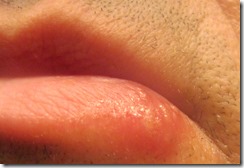
Polling Pebbles :  Cold sore on  lower lip
Cold Sore on lower lip  - Rolling Pebbles Files©

Cold sores aren’t a problem for everyone but for those who suffer, outbreaks can be painful, uncomfortable, and embarrassing. In fact, up to 90 per cent of adults carry  herpes simplex virus type 1 (HSV-1), but only 20 to 40 per cent will ever experience a cold sore outbreak. When most people hear herpes they think of the sexually transmitted infection that causes sores in the nether regions (genital herpes) and they’d be right. Most cases of genital herpes are caused by herpes simplex virus type 2 (HSV2) while most cold sores are cause by HSV1 but both viruses can (although much less common) cause sores in the opposite region if the active virus comes in contact with that region (you possibly can imagine how). Most cold sore sufferers aren’t exactly sure when they first encountered the virus, but once contracted the virus never leaves the body.
Not everyone’s cold sore is triggered by the same thing. But there are several common factors that may cause your outbreaks. Knowing general cold sore triggers can help you identify personal triggers and take the necessary steps to manage them.
First, boost your immune system by getting plenty of rest and exercise and eating a balanced diet. Avoiding the stress in your life is also important. Keep your lips moisturized – drink plenty of water to stay hydrated and use sunblock on your lips all year round to protect your lips from sun and from winter cold.
Treat your cold sore early for best results. The best time to start treatment is when that tingling sensation first happens, before any visible sign of a cold sore appears. When it comes to treating a cold sore, you’ll hear advice on everything from home remedies to lip balm cures.
Learn the cold sore facts so you can face every cold sore with confidence. Ice, vinegar, tea bags, camphor, menthol or phenol may provide temporary relief, but they won’t make your cold sore disappear faster. Look for products that contain the medicinal ingredient, docosanol, which is clinically proven to shorten the duration of a cold sore.It is marketed by Healthcare Brands under the name Erazaban in Europe and Abreva in U.S.A. and Canada.

Remember to avoid transmitting the virus to others through skin contact (kissing is the first thing coming to mind). Cold sores are most contagious when someone has an open blister present on their lips until the point where the blister has completely healed.  At the same time, note that certain people can spread the virus through their saliva even if there is no open blister present.Also, wash your hands frequently if you’ve touched your lips or brushed your teeth to avoid spread of the virus.

February 22, 2013

More facts about Vitamin D

 This month, anyone who lives north of sunny Atlanta is sunshine starved and therefore Vitamin D deficient. So, unless you have plans to fly south soon, you had better have a backup plan.
Milk (and some brands of milk products, like yogurt) are Vitamin D fortified.
But, the amounts aren’t high enough to ensure you are topped up to a protective level to prevent osteoporosis, cancer and, studies are showing, many other chronic illnesses.Here are some good sources:

  1. Salmon
  2. Cod liver oil
  3. Liver
  4. Eggs
  5. Caviar
  6. Greek caviar dip taramosalata 
Above is reblogged from Metronews

Helth organizations reticently upgraded their daily overall recommended doses of Vitamin D to  1000UI (international units) from different sources (sun,food,supplements). It is reported that for cancer prevention, individuals taking 1,000 IU of oral vitamin D daily had a lower incidence of colon cancer.
See also Low levels of vitamin D in blood double risk of bladder cancer in this blog.

Search This Blog