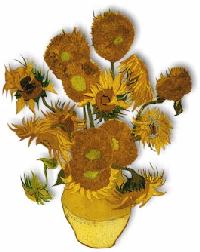
 They are some of his best-known work and the colour yellow was, for Vincent van Gogh, a symbol of happiness. So the idea that any of his series of vivid masterpieces – Sunflowers – is slowly turning brown would surely have been painful to the Dutch painter.
 The renowned canvases are among dozens of great works that are said to be changing colour, and now scientists have revealed that this is due to exposure to energy-efficient lights installed in art galleries and museums across the world.
Scientists have discovered that the bright-yellow pigment featured in several famous artworks becomes unstable under LED lights and, over time, turns a shade of brownish green. A sample of 14 works from the period between 1887 and 1890 were tested for the reaction which affects the oil paint colour known as chrome yellow. It was favoured by 19th-century artists and has been found in important works by Paul Cézanne and Paul Gauguin.
Researchers have now warned galleries and museums to reconsider the use of some LED lighting to prevent the colours in such paintings deteriorating further.
Claus Habfast, from the European Synchrotron Radiation Facility in France, where some of the artworks were studied, said: "LED lights appear to have many advantages but museums should carefully consider that paintings from the Van Gogh era could be affected by them.
"Paintings that have moderate darkening will find this accelerates in the coming years.
"Of course, it's not advisable to put these paintings in the dark because they are part of the cultural heritage of humankind and the public wants to see them. But museums have to strike the right balance."
LED lighting has become an increasingly popular choice with art institutions in recent years as an energy-efficient alternative to fluorescent light bulbs. It was also thought to provide better protection for pictures by avoiding the harm caused by the effects of natural light and other forms of illumination.
But a series of experiments provoked by art curators' growing fears that a number of their masterpieces were darkening in colour has suggested that some types of LED lights may be to blame for the damage.
A team of scientists in France and Germany used ultra-powerful X-ray technology to analyse the bright-yellow tones in paintings by Van Gogh, Cézanne and Gauguin.
The research focused on three shades of chrome-yellow paint, which is otherwise known as lead chromate. The most regular form of this colouring, middle yellow, was found to be chemically stable. But two other variations – primrose and lemon shades – began to turn brown or olive green when placed under the green-blue rays emitted by some LED lights.
Letizia Monico, who was part of the research group that conducted the experiment, said they found a number of masterpieces had been affected by this reaction.
She said: "We have found the unstable forms of chrome yellow in several well-known paintings, such as Portrait of Gauguin and the famous Vase with Sunflowers at the Van Gogh Museum in Amsterdam."
Find the whole story here: http://www.independent.co.uk/arts-entertainment/art/news/sunflowers-wilt-van-goghs-masterpiece-is-slowly-turning-brown-as-a-result-of-exposure-to-led-lighting-8449304.html


